IFC Test Testking - Reliable IFC Exam Review
Wiki Article
BONUS!!! Download part of TorrentValid IFC dumps for free: https://drive.google.com/open?id=1tfikaBHUYAOqPD6amxKrg7pqbhYOHkSq
With the development of artificial intelligence, we have encountered more challenges. Only by improving our own soft power can we ensure we are not eliminated by the market. Select IFC study questions to improve your work efficiency. And you won't regret for your wise choice. Because our IFC Exam Materials contain the newest knowledage in this subject. And our IFC training guide is beening updated from time to time to be up-to-date. What is more, you will get the certification with the help of our IFC practice engine.
CISI IFC Exam Syllabus Topics:
| Topic | Details |
|---|---|
| Topic 1 |
|
| Topic 2 |
|
| Topic 3 |
|
| Topic 4 |
|
| Topic 5 |
|
| Topic 6 |
|
| Topic 7 |
|
IFC Test Testking | High-quality Investment Funds in Canada (IFC) Exam 100% Free Reliable Exam Review
With the popularization of wireless network, those who are about to take part in the IFC exam guide to use APP on the mobile devices as their learning tool, because as long as entering into an online environment, they can instantly open the learning material from their appliances. Our IFC study materials provide such version for you. The online test engine is a kind of online learning, you can enjoy the advantages of APP version of our IFC Exam Guide freely. Moreover, you actually only need to download the APP online for the first time and then you can have free access to our IFC exam questions in the offline condition if you don’t clear cache.
CISI Investment Funds in Canada (IFC) Exam Sample Questions (Q334-Q339):
NEW QUESTION # 334
What is the current yield on a $5,000 Government of Canada bond paying a 6% coupon and trading at a price of $102 (rounding to the nearest hundredth)?
- A. 6.00%
- B. 6.12%
- C. 4.90%
- D. 5.88%
Answer: A
Explanation: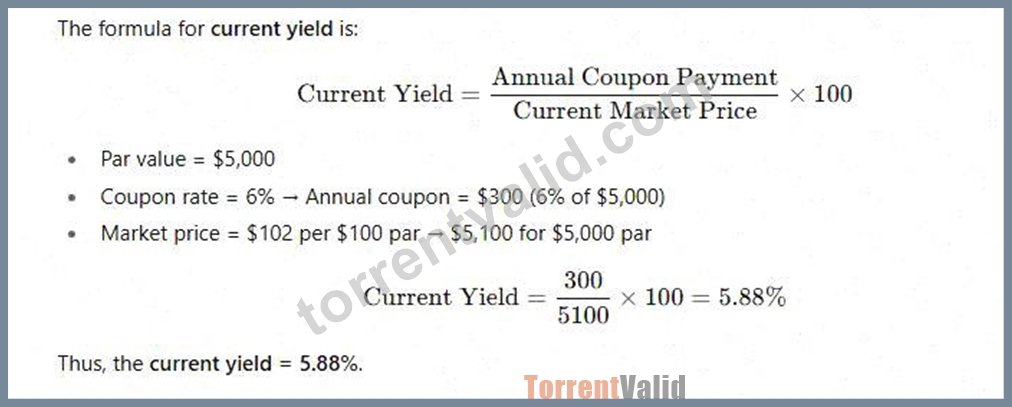
NEW QUESTION # 335
Which of the following could be a passively managed fund?
- A. hedge fund
- B. commodity pool
- C. labour-sponsored investment fund
- D. exchange traded fund (ETF)
Answer: D
Explanation:
A passively managed fund is a type of investment fund that follows a predetermined strategy or rule to track the performance of a market index, such as the S&P 500, or a specific sector, such as technology or health care. A passively managed fund does not involve active decision-making by the fund manager, who simply replicates the composition and weighting of the index or sector. A passively managed fund aims to match the return and risk of the index or sector, rather than outperform it. A passively managed fund typically has lower fees and expenses than an actively managed fund, as it requires less research, trading, and oversight.
An exchange traded fund (ETF) is a type of passively managed fund that trades on a stock exchange like a common stock. An ETF holds a basket of securities that mirrors an index or sector, and its price fluctuates throughout the day based on supply and demand. An ETF allows investors to gain exposure to a diversified portfolio of securities with low costs, high liquidity, and tax efficiency.
A commodity pool is a type of investment fund that invests in futures contracts or options on commodities, such as oil, gold, or wheat. A commodity pool is usually actively managed by a commodity trading advisor (CTA), who uses various strategies to generate returns from the price movements of commodities.
A hedge fund is a type of investment fund that employs sophisticated and often aggressive strategies to achieve high returns and reduce risk. A hedge fund is usually actively managed by a hedge fund manager, who has wide discretion and flexibility to use various instruments, such as derivatives, leverage, short selling, arbitrage, etc. A hedge fund is typically available only to accredited investors who meet certain income and net worth criteria.
A labour-sponsored investment fund (LSIF) is a type of investment fund that provides venture capital to small and medium-sized Canadian businesses, while offering tax benefits to investors. An LSIF is usually actively managed by a labour union or an organization affiliated with a labour union, who selects the companies to invest in based on their potential for growth and job creation.
Canadian Investment Funds Course, Chapter 4: Types of Investments1
NEW QUESTION # 336
Darryl has a diversified investment portfolio of mutual funds in a non-registered account with Investwell Mutual Funds, a mutual fund dealer. Darryl's diversified portfolio is composed of 3 mutual funds. Each mutual fund is currently worth about $100,000. The ABC Canadian Equity Fund has a total return of 6%, the DEF Bond Fund has a total return of 8% and GHI Global Equity Fund has a total return of 10%. Darryl wants to make an in-kind contribution to his registered retirement savings plan (RRSP) account. He has unused RRSP contribution room of $60,000.
From a tax-efficient viewpoint, which funds contribute in-kind to his RRSP account?
- A. Move $20,000 from each of the three funds to the RRSP.
- B. Move the ABC Canadian Equity Fund to the RRSP.
- C. Move the DEF Bond Fund to the RRSP.
- D. Move the GHI Global Equity Fund to the RRSP
Answer: C
Explanation:
Moving the DEF Bond Fund to the RRSP would be more tax-efficient than moving any of the other funds.
This is because bond funds generate interest income, which is fully taxable at the investor's marginal tax rate in a non-registered account. By moving the bond fund to an RRSP, Darryl can defer paying taxes on the interest income until he withdraws it from the RRSP. Moving the GHI Global Equity Fund to the RRSP (B) would not be tax-efficient, as global equity funds generate foreign income and dividends, which are subject to foreign withholding taxes in an RRSP. Moving $20,000 from each of the three funds to the RRSP would not be tax-efficient, as it would trigger capital gains taxes on all three funds in proportion to their returns.
Moving the ABC Canadian Equity Fund to the RRSP (D) would not be tax-efficient, as Canadian equity funds generate Canadian dividends, which are eligible for a dividend tax credit in a non-registered account. By moving the Canadian equity fund to an RRSP, Darryl would lose this tax advantage and pay taxes on the dividends at his marginal tax rate when he withdraws them from the RRSP.
NEW QUESTION # 337
What portion of the withdrawal from a Registered Educational Savings Plan is tax-free?
- A. Capital gains earned
- B. Canadian Educational Savings Grant (CESG) amounts
- C. Dividend income earned
- D. Original capital contributed
Answer: D
Explanation:
Comprehensive and Detailed Explanation From Exact Extract:
The original capital contributed to a Registered Educational Savings Plan (RESP) is not taxed upon withdrawal, while other amounts, such as income or grants, are taxable to the beneficiary. The feedback from the document states:
"The original capital withdrawn from an RESP is not taxed; all other amounts are taxed in the hands of the beneficiary." Reference:Chapter 6 - Tax and Retirement PlanningLearning Domain:The Know Your Client Communication Process
NEW QUESTION # 338
What type of fund offers the highest expected risk and the highest expected return in terms of the risk-return trade-off between different types of mutual funds?
- A. Specialty fund
- B. Real estate fund
- C. Canadian Equity fund
- D. Mortgage fund
Answer: A
Explanation:
Specialty funds, due to their focused and often speculative investments, carry the highest expected risk and return among mutual funds. The feedback from the document states:
"The highest risk, highest expected return mutual fund is a specialty fund." Reference: Chapter 15 - Selecting a Mutual FundLearning Domain: Evaluating and Selecting Mutual Funds
NEW QUESTION # 339
......
While the CISI IFC practice questions pdf can help you learn all the relevant answers for the Investment Funds in Canada (IFC) Exam, TorrentValid also provides an online Sitecore Practice Test engine to enhance your confidence and skills. This practice test engine is an effective tool for both learning and practicing CISI IFC Exam.
Reliable IFC Exam Review: https://www.torrentvalid.com/IFC-valid-braindumps-torrent.html
- Pass Guaranteed Quiz 2026 IFC: High Hit-Rate Investment Funds in Canada (IFC) Exam Test Testking ???? Copy URL ⇛ www.dumpsquestion.com ⇚ open and search for ➽ IFC ???? to download for free ????100% IFC Exam Coverage
- Reliable IFC Test Pass4sure ☯ IFC Dumps Cost ???? New Soft IFC Simulations ???? Download ➤ IFC ⮘ for free by simply entering ▛ www.pdfvce.com ▟ website ????Study IFC Test
- Pass Guaranteed CISI - IFC Accurate Test Testking ???? Simply search for { IFC } for free download on ➥ www.practicevce.com ???? ⌚New Soft IFC Simulations
- IFC Exam Brain Dumps ???? IFC Dumps Cost ???? Reliable IFC Test Pass4sure ???? Enter ☀ www.pdfvce.com ️☀️ and search for 【 IFC 】 to download for free ????IFC Reliable Exam Book
- IFC Test Testking Exam Pass Once Try | CISI Reliable IFC Exam Review ???? Search for 《 IFC 》 and download exam materials for free through [ www.dumpsquestion.com ] ????IFC Study Center
- IFC Clear Exam ???? Study IFC Test ???? New IFC Test Pdf ???? Copy URL ▷ www.pdfvce.com ◁ open and search for { IFC } to download for free ????New IFC Test Pdf
- Latest IFC Exam Bootcamp ???? IFC Valid Test Review ???? IFC Study Center ???? Easily obtain 「 IFC 」 for free download through 《 www.troytecdumps.com 》 ????New IFC Test Pdf
- Pass IFC Exam with High-quality IFC Test Testking by Pdfvce ???? Copy URL 《 www.pdfvce.com 》 open and search for ⇛ IFC ⇚ to download for free ⚽Reliable IFC Test Pass4sure
- Updated CISI - IFC Test Testking ???? The page for free download of ➥ IFC ???? on ⏩ www.vce4dumps.com ⏪ will open immediately ????Latest IFC Exam Bootcamp
- CISI IFC Desktop - Practice Test Software By Pdfvce ???? Copy URL ➡ www.pdfvce.com ️⬅️ open and search for ▛ IFC ▟ to download for free ????New IFC Test Pdf
- Pass Guaranteed Quiz IFC - Investment Funds in Canada (IFC) Exam Fantastic Test Testking ???? Download ▛ IFC ▟ for free by simply entering ⮆ www.verifieddumps.com ⮄ website ⛷IFC Valid Test Review
- albiexoik706593.blogdal.com, barbaramvmv701704.creacionblog.com, www.stes.tyc.edu.tw, www.stes.tyc.edu.tw, www.stes.tyc.edu.tw, scrapbookmarket.com, jayasdyf012529.wikifiltraciones.com, nellyunp008496.get-blogging.com, chiararbvo753275.blgwiki.com, mysocialport.com, Disposable vapes
P.S. Free 2026 CISI IFC dumps are available on Google Drive shared by TorrentValid: https://drive.google.com/open?id=1tfikaBHUYAOqPD6amxKrg7pqbhYOHkSq
Report this wiki page